

MANILA — Elimination of tumor is the primary goal of cancer treatment. A remedy that extends patient survival but poses trouble on matters concerning the heart.
The Philippine Heart Association (PHA) has launched the PINAS-VTE (Philippine Incidence and cliNical outcomes among cAncer patientS with Venous ThromboEmbolism) Study, the first in its kind nationwide.
It revealed that nearly 15 percent of Filipino cancer patients develop dangerous, potentially life-threatening venous blood clots within just six months of their diagnosis.
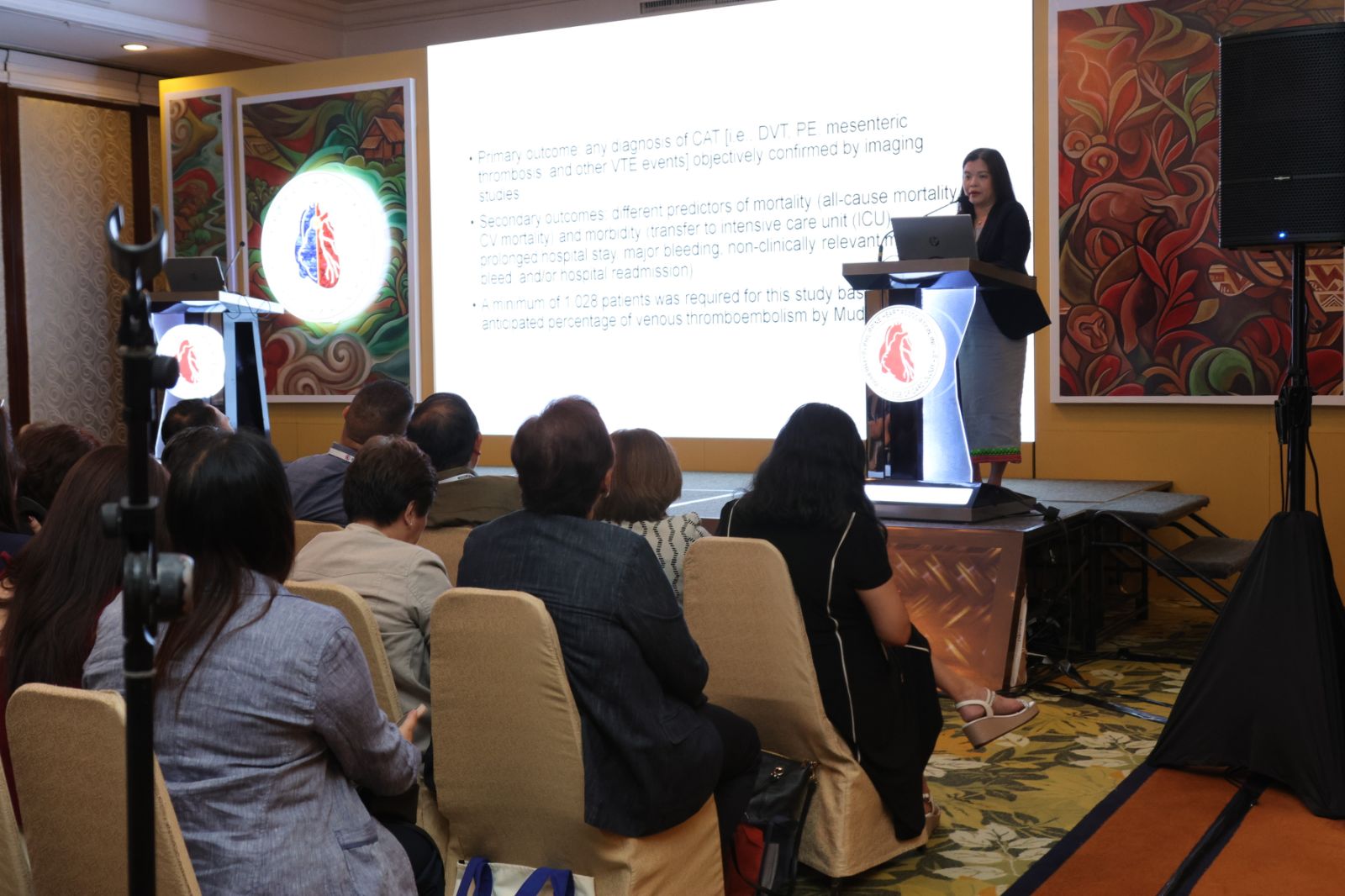
PHA Clinical Cardio-Oncology Council Research Fellow Dr. Angela Apostol-Alday presented the six-month interim data during a joint session on September 17, 2026 at the PHA 56th Annual Convention and Scientific Meeting.
"I cannot count the number of times that our society had to lecture about cancer-associated thrombosis, and yet we couldn't even cite a number that would reflect the incidence or the prevalence of cancer-associated thrombosis in our own country," she said.
Citing issues on borrowing data from Western studied, she noted that standard risk scores used to predict whether a patient will clot or bleed have never been widely validated in Filipinos.
This sparks an urgent push among local medical experts to abandon western "one-size-fits-all" risk models in favor of localized, aggressive preventive screening.
Until now, Filipino physicians treating cancer-associated thrombosis (CAT) have had to rely entirely on clinical data and risk-prediction scores derived from Western populations or neighboring Asian countries.
The study, which is funded by the PHA, tracked 326 adult patients diagnosed with solid tumors or hematologic malignancies across 10 medical sites in Luzon, Visayas, and Mindanao.
It revealed that 48 patients or 14.7 percent developed venous thromboembolism (VTE) within six months of their cancer diagnosis.
The vast majority of these cases manifested as deep vein thrombosis (DVT) in the extremities, followed by pulmonary embolisms (PE) and mesenteric venous thrombosis.
To put that figure into perspective, the American Society of Hematology (ASH) classifies a six-month VTE risk of 9.5 percent or higher as "high risk." The local cohort significantly overshot this threshold.
The data also highlighted clear clinical red flags. VTE occurred with significantly higher frequency in patients with aggressive, hypercoagulable cancer profiles—specifically those with pancreatic cancer (which saw a 36 percent VTE rate) and adenocarcinoma histologies.
On multivariate analysis, several independent predictors tied directly to an elevated risk of clotting, including:
* A history of hospitalization within 60 days prior to the clot diagnosis
* Adenocarcinoma histology
* Pre-existing heart failure or cardiomyopathy
* Chronic liver disease
Beyond establishing local baseline numbers, the study yielded a critical, practice-changing insight regarding how doctors screen patients.
Investigators compared two widely used Risk Assessment Models (RAMs): the Western-centric Khorana score and the globally recognized ONCOTEV score.
The results showed that the ONCOTEV score was far more accurate and significantly associated with the actual occurrence of VTE in Filipino patients than the Khorana score.
Strikingly, even an ONCOTEV score of 1—traditionally categorized as low-risk—was found to be a statistically significant indicator of clot development in the local cohort.
Crucially, the study noted that the incidence of life-threatening clots heavily outweighed major bleeding events, which occurred in only three patients.
This imbalance suggests that the threat of under-treating or failing to prevent a clot is a much larger clinical danger than the risk of bleeding caused by preventive blood thinners.
Health experts argue the data provides a compelling mandate for more aggressive, routine VTE prophylaxis (preventive treatment) using low-molecular-weight heparins like enoxaparin or direct oral anticoagulants like apixaban.
Because the study was purely observational, managing physicians had a completely free hand in patient treatment.
Data showed that out of the patients who did develop clots, 39 were put on anticoagulants, while others had therapy withheld due to active major bleeding or critically low platelet counts.
Despite logistical limitations—including a reduced sample size caused by a mid-study drop from 18 to 10 participating sites—the interim results offer a vital foundation for a permanent national cancer-associated thrombosis registry.
Medical pioneers say the implementation of this local data must accelerate to match the rapid pace of cancer drug innovations.
For Filipino oncology patients, the findings represent a crucial step toward a medical strategy that protects the heart and circulatory system with the exact same vigor used to fight the tumor.
"We had to finish this despite the limitations and the challenges, of course, for the Filipino people," Dr. Apostol-Alday said.


