

For many Filipinos living in far-flung island provinces, surviving a heart attack can still depend on geography.
In some areas of the country, getting access to specialized cardiovascular care which is islands away takes hours or even days. Patients travel by land, sea, or air just to see a heart doctor. In emergency cases where “time is muscle,” those delays can mean the difference between life and death.
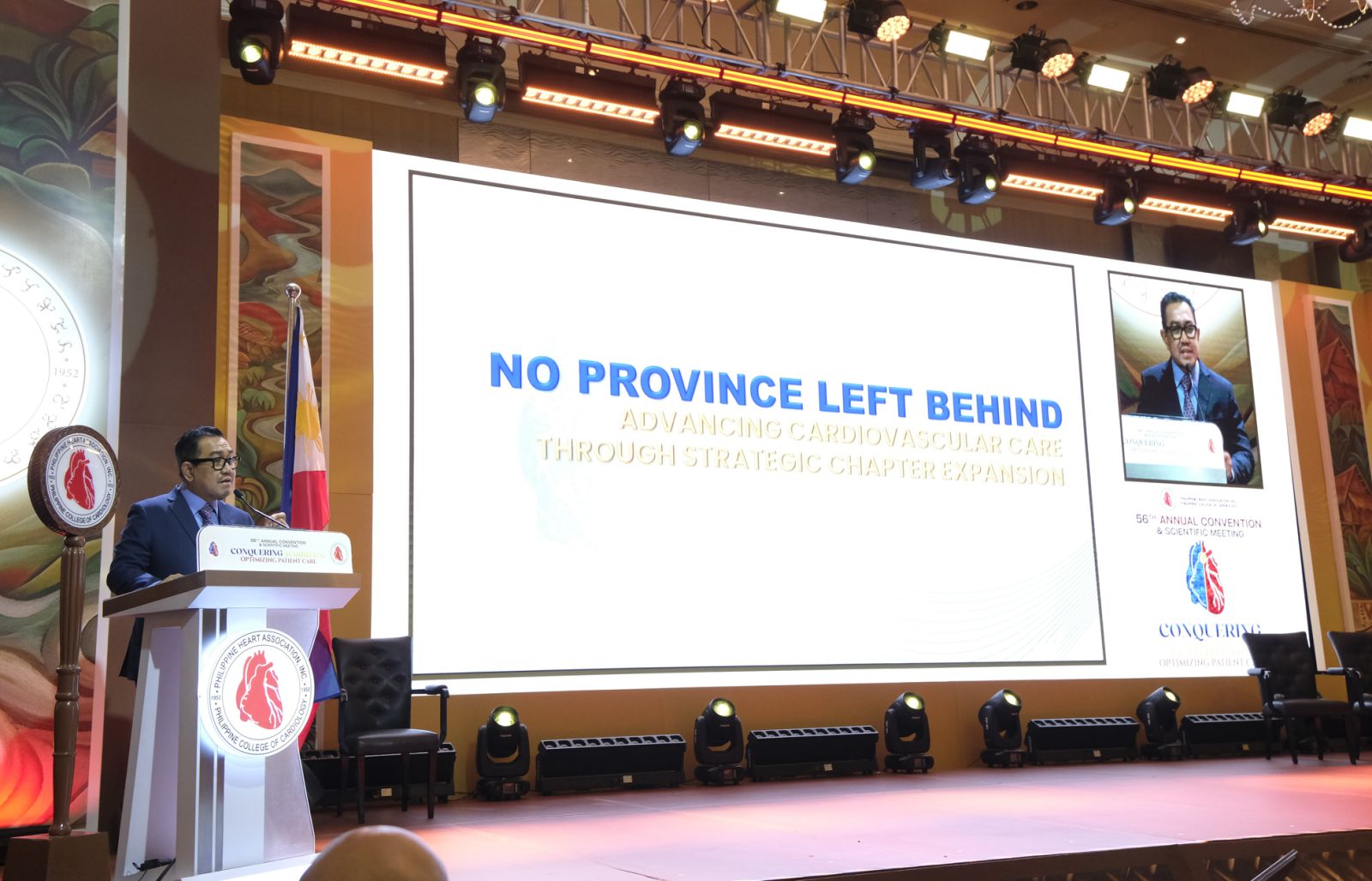
This harsh reality was the centerpiece of the Presidential Plenary Lecture of Dr. Walid A. Amil, president of the Philippine Heart Association (PHA), during the PHA 56th Annual Convention and Scientific Meeting, where he reiterated that the organization’s most ambitious goal: “One cardiologist for every city or province” is a work in progress.
“Today, in our country, your chance of surviving a heart attack can still depend on your zip code, and that is something we need to change,” he said.
Coming from a provincial chapter himself, Dr. Amil described the advocacy as deeply personal.
After serving on the PHA board for seven years, he said he realized that medical programs and advocacies become most powerful only when they reach the grassroots.
“If we do want to bring heart care closer to every Filipino, we cannot remain too centralized,” he said. “The true strength of PHA is not only in Metro Manila, but in every province, every island, and every community we serve.”
A healthcare divide across islands
The Philippines, an archipelago of more than 7,000 islands, continues to face uneven access to cardiovascular care despite advances in medicine and technology.
According to Dr. Amil, more than half of the PHA’s 2,500 members are still concentrated in Metro Manila, while only 48 percent serve the rest of the country’s more than 110 million Filipinos.
Even among provincial chapters, nearly 70 percent of cardiologists are clustered in six large regional chapters (Southern Tagalog, Cebu, Central Luzon, Northwestern Mindanao, Davao Southern Mindanao, and North Luzon), often limiting activities to urban centers while geographically isolated and disadvantaged areas (GIDA) remain underserved.
Dr. Amil revealed that 15 provinces in the Philippines (Batanes, Mountain Province, Kalinga-Apayao, Ifugao, Quirino, Zamboanga Sibugay, Basilan, Sulu, Tawi-Tawi, Masbate, Romblon, Biliran, Siquijor, Camiguin, and Dinagat Islands) still have no resident cardiologist at all.
“Patients in these areas are forced to travel hundreds of kilometers just to receive specialized cardiovascular care,” he said. “This is a reality we cannot ignore.”
The situation prompted the PHA leadership to prioritize strategic chapter expansion as its flagship initiative.
Rather than concentrating resources in major cities, the organization aims to decentralize cardiovascular advocacy through the creation of new chapters and subchapters that can directly operate in remote communities.
“This is not about splitting chapters,” Dr. Amil emphasized. “This is about multiplying the impact.”
Building chapters, building access
In less than a year, the PHA established three new chapters: Bohol, Capiz-Aklan, and Negros Oriental-Dumaguete.
The Bohol chapter was launched on September with 12, 2025, with Dr. Jane Ramiro as founding president. This was followed by the creation of the Capiz-Aklan chapter in November 2025 under the stewardship of Dr. Rommel Mosquete, and the Negros Oriental-Dumaguete chapter in February 2026 led by Dr. Brian Calinawagan.
Dr. Amil said the birth of chapter and sub-chapters allows cardiovascular programs to move beyond major cities and penetrate communities that previously had little direct engagement with the organization.
“These early wins show us that chapter expansion is not just adding names on a map,” he said. “It is about creating active communities that educate, mobilize, and inspire action.”
The newly formed chapters have already begun conducting Heart Month caravans, CPR training, public health campaigns, media engagements, and scientific activities in the barangay level.
According to Dr. Amil, local chapters possess a critical advantage: they understand the realities and needs of their own communities.
“They move faster and bring cardiovascular advocacy closer to the Filipino people,” he said.
The BaSulTa model
The PHA’s most groundbreaking initiative, however, took place in the country’s southern frontiers, on the island provinces of Basilan, Sulu, and Tawi-Tawi in Western Mindanao.
For decades, these provinces had no practicing cardiologists and no access to heart care.
“Every heart emergency became a race against time,” Dr. Amil said.
To address the gap, the PHA, together with the ZamBaSulTa Chapter, established three new subchapters in Basilan, Sulu, and Tawi-Tawi earlier this year.
Unlike full chapters composed mainly of cardiologists, these subchapters are built by empowering local physicians from various specialties as PHA associate members.
Fifteen physicians from the Basulta region were inducted into the organization to serve as local partners in implementing cardiovascular programs and advocacy campaigns.
Through mentorship and collaboration with cardiologists from the main chapters, these physicians are expected to help bridge the gap in areas where specialist care remains absent.
“This is pioneering healthcare. Not through medicine alone, but through partnership, education, early intervention, and action,” Dr. Amil said.
Close to 2,000 frontliners and residents underwent mass hands-only CPR training across the islands, while public lectures on hypertension, stroke, ischemic heart disease, and healthy lifestyle practices were also conducted.
Planting future cardiologists
Beyond immediate outreach efforts, the PHA is also investing in long-term solutions by developing future cardiologists from underserved provinces themselves.
Dr. Amil revealed that the organization identified three potential cardiology fellowship trainees from Basilan, Sulu, and Tawi-Tawi—all practicing internists who may eventually become the first cardiologists in their respective provinces.
The PHA formally reached out to all 27 cardiology fellowship training programs in the country, requesting consideration and support for the applicants.
If accepted into training, the physicians are expected to return to their home provinces after completing fellowship.
“God willing, in the next three to four years, they will return to Basilan, Sulu, and Tawi-Tawi, potentially becoming the first batch of cardiologists in their respective regions,” he said.
Technology bridging the distance
Recognizing the limitations, the PHA also plans to maximize tele-cardiology and digital communication systems.
Among the proposed strategies are remote ECG interpretation through platforms such as Viber or Telegram, virtual cardiology consultations, and online lectures on managing cardiac emergencies in low-resource settings.
The organization also continues forging partnerships with local government units and provincial health offices to integrate cardiovascular programs into local healthcare systems.
Expanding hope
Despite the momentum, Dr. Amil acknowledged the enormous challenges ahead—from manpower shortages and funding constraints to infrastructure limitations and geographic isolation.
He urged young cardiologists and healthcare professionals to see service in rural areas not as sacrifice, but as mission.
“To our fellows and young cardiologists, go where you are most needed, not only where it is most convenient,” he said.
“One province, one cardiologist, and one Filipino at a time,” Dr. Amil added.


